
As teachers, we all know those tricky moments in class when a child’s behaviour catches us off guard. That's where ABC behaviour charts come in handy. They can be useful tools to help us understand, track and address challenging behaviours in a systematic way. By breaking down incidents into their parts, we can spot what sets off certain behaviours and see how our responses might affect what happens next.
What is the ABC model of behaviour?
Think of ABC as a simple way to understand behaviour: Antecedent, Behaviour, and Consequence. It's rather like a story with a beginning, middle and end:
- Antecedent: What happened just before (the trigger)
- Behaviour: What the child actually did
- Consequence: What happened afterwards
Why use the ABC approach in your classroom?
You'll find this approach really useful because it:
- Helps you spot patterns in tricky behaviours
- Gives you solid evidence instead of gut feelings
- Makes behaviour management more effective
- Helps when chatting with colleagues and parents
- Makes it easier to create personalised support plans
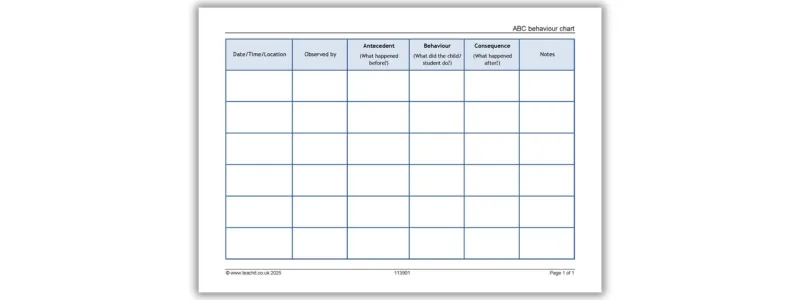
Understanding ABC behaviour charts
These charts are straightforward recording tools. Here's what you'll want to jot down:
- When it happened
- What led up to it
- What the pupil did
- What happened next
- Any patterns you've noticed
Try our practical, ready-to-use ABC behaviour chart template which is designed to make recording and analysing challenging behaviour in your classroom easier and more effective.
Making the most of ABC charts
Here's how to get the best out of your charts:
- Stick to the facts: Write what you see, not what you think about it
- Be precise: Instead of "misbehaved", write exactly what happened
- Keep at it: Fill it in straight after incidents
- Look for patterns: Have a good look through each week
- Share wisely: Use your findings in staff meetings and parent consultations
What to note about antecedents
Keep an eye out for:
- What time it was
- Where it happened
- Who else was there
- What was going on
- The environment (was it noisy, hot, etc.)
- Any changes to the normal routine
Recording the behaviour
When writing down what happened:
- Be crystal clear about what you saw
- Don't use labels or judgements
- Note how long it lasted if that's important
- Mention how intense it was
- Track if it keeps happening
Noting down consequences
Make sure to include:
- How staff responded
- How other children reacted
- What naturally happened next
- Any changes in the classroom
- How the child responded to what happened
Putting your findings to work
Once you've gathered your ABC data, use it to:
- Spot triggers you can change or remove
- Work out how to prevent issues
- Plan better ways to respond
- Create tailored support plans
- Check if your strategies are working
Remember, these charts work best as part of your school's overall approach to behaviour. They're meant to support your professional judgement, not replace it. After all, you know your children best!

